Self Ordering Terminal (SOT) for a robotic kitchen inside a shipping container called SAM
Get Licensed
Built on Cursor AI-Self Ordering Terminal (SOT)
Year
2025
At Goodbytz we are developing the world’s first autonomous robotic kitchen infrastructure for defence applications
Impact & Insights

Overview
As part of this project, we are introducing our new containerized 20-foot system. It is designed for international use in remote and infrastructure-limited environments, from defense to emergency response to event catering.
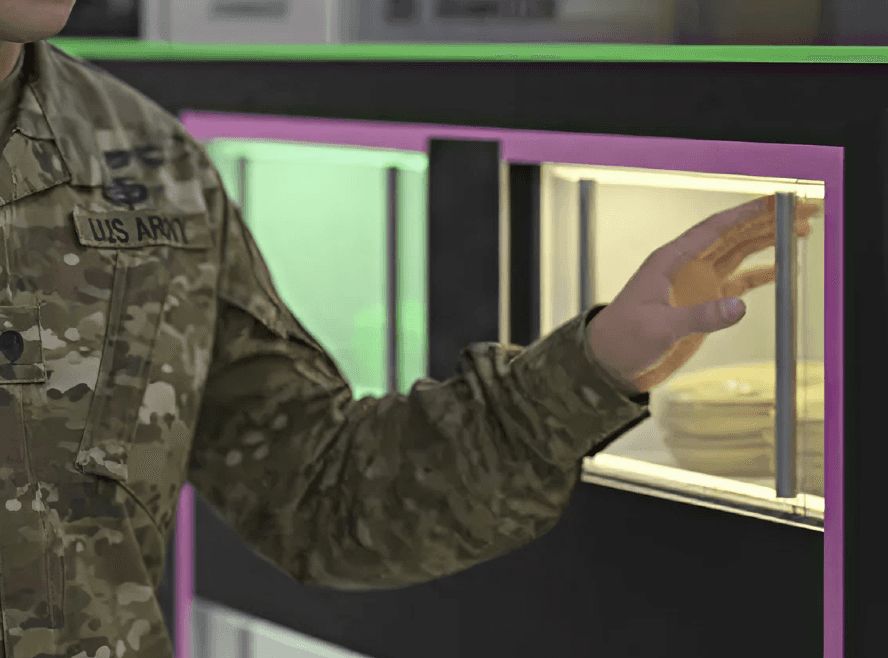
SAM is a pioneering project designed to provide automated, high-quality meals to soldiers in the field. The system is housed within a mobile shipping container, allowing it to be transported via trailer to any location. Inside, a robot prepares meals, while soldiers interact with dual-screen terminals to place their orders.
Role: UX/UI Designer & Front-end Implementer
Tools: Figma, Cursor (AI Code Editor), v0, Node.js, React
Key Focus: Digital-Physical Integration, Military UX, AI-Assisted Development, Multi-language Support (English & Korean).

The Challenge
The project faced unique environmental and behavioural constraints:
Mobility & Durability: The interface had to reflect the rugged, industrial nature of a shipping container.
Speed of Deployment: We needed to design, prototype, and code the front-end rapidly for integration with the robot's back-end.
Research & Discovery
Through physical product designers and field researchers, we identified two primary user groups:
The Soldier (End User): Needs a fast, high-contrast, easy to-use interface to order food under various lighting conditions.
The Operator (Admin): Requires a secure area (pin-code protected) to manage settings and system health.
Key Insight:
Our researchers noticed a "patience gap." Soldiers expected instant access to their food. We realised we needed a visual bridge between the digital screen and the physical locker.
Design Strategy
Visual Identity
I chose a Dark Military Theme to match the black shipping container.
Assets: High-quality food imagery combined with sharp branding elements.
Typography & Layout: Optimized for 1920×1080 resolution tablets.
Accessibility: High contrast for outdoor/industrial visibility.
Solving the "Locker Tension"
To prevent soldiers from forcing the lockers, I collaborated with the Industrial Designer to create a sync animation.


Prototyping & Testing
I developed the initial high-fidelity designs in Figma
Usability Testing: We tested the flow on 1920×1080 tablets to ensure touch targets were appropriate for soldiers (who might be wearing gear).
Bilingual Validation: We implemented a toggle for English and Korean, ensuring the UI remained balanced and readable in both scripts.

AI-Powered Implementation (The Tech Stack)
To accelerate development and ensure the final product matched the design pixel-for-pixel, I leveraged AI coding tools:
Exploration: Evaluated Figma AI, v0, and Replit for code generation.
Execution: Used Cursor to build the full React front-end.
Process: I translated Figma layouts into clean HTML/CSS and React components. This allowed for rapid iterations and real-time responsiveness testing on the actual tablet hardware.
Collaboration: I worked closely with the back-end developers to ensure the React app was ready for GitHub and seamless integration with the robot's Python-based logic.


Results & Impact
To accelerate development and ensure the final product matched the design pixel-for-pixel, I leveraged AI coding tools:
Seamless Integration: Successfully bridged the gap between the digital UI and the physical robotic hardware.
Reduced Damage: The locker animation successfully modified user behavior, reducing the risk of mechanical failure.
Efficiency: Using AI (Cursor) reduced the development timeline, allowing for a functional prototype to be delivered to the back-end team ahead of schedule.
More Projects


Figma
Figma
Trello
Claude
ChatGPT
Blender
Framer
Webflow
Rive
Trello
Trello